Archive for the ‘Shelley Widhalm, Writer’ Category

A Writer’s Quarterly Review

Sunday, May 6th, 2012

Businesses do it for survival, but I figured as a writer, I could glean my own form of a quarterly review.

I’ve just finished month four of my yearlong blog of 52: A Year of Writing Basics, Beliefs and Beauty.

A little late, my review is three months, plus one.

Each week, I am tackling a writing topic, starting with the basics of Plot, Setting, Character, Dialogue and Pacing to fire up the big guns in my writer’s toolbox.
The BIG guns, you ask.

Before opening the toolbox, I want to key in on the essentials of writing a story or novel.

There has to be a hook in the beginning that contains a strong inciting incident. This incident triggers the main character’s problem or submerges him or her into trouble. She wants something but has to face obstacles that block the path to obtaining her goals and desires.

The telling of her story begins in the middle of the action to achieve a level of pacing that draws in the reader. The exciting moment is what gets readers turning the page, which likely won’t happen if the telling is bogged down with back story or has to start at the beginning without anything interesting happening.

Wherever they appear in a story, flashbacks should retell what happened before the story’s action begins and are triggered by something specific, such as a character seeing an object and remembering something because of it.

The story unfolds as a series of scenes strung together with a beginning, middle and end, or the arc of the entire telling. The outcome of each scene is what moves the plot forward.

What the story is about and why it matters is the theme, which offers insights or comments about the human experience.

The setting grounds the character in his or her reality without drawing too much attention to the words.

Voice comes through word choice and how words are put together to describe things.

Unlike that of the author, a character’s voice is revealed in her behaviors and attitudes to those around her. Her dialogue is reduced to the essentials, leaving out the normal repetitions, tangents and diversions that occur in regular conversation.

The elements of fiction are just one aspect of my toolbox, as are my hammer, nails, screwdriver and pliers that represent my paper, pen, laptop, journals and the other things I need to do the writing.

The specifics of what is in a writer’s toolbox will be continued to next week, because my quarterly review has two parts. Like some CEOs, I need lots of paper to make a point.

A Pumpkin Tale

Friday, April 6th, 2012

Here is a 200-word story I wrote in 2000 that I like for its simplicity and the story it tells:

A Pumpkin Tale

I live on 5th Avenue next to a rotting pumpkin patch. The smell of old pie, raw and sticky, reminds me of walks Pa and I took in the late summers. He knotted his fingers over my hand, engulfing it in his strength. I was his toy pulled along by stringy arms. If I stumbled, I had to be the one to balance while running to make up for lost steps.

I grew. My gangly limbs gained strength as my body expanded. My pa did not explain to me why my body changed.

I became tall, taller than he, and on our walks, he stopped holding my hand.

But he still talked.

“God damn corn this year. I aint gonna get a crop.”

“What about the pumpkins?” I asked, breathless as I ran.

He walked steadily.

“They are weeds,” he said. “They were here when I got this here farm.”

What about me? I wanted to ask.

In my house on 5th Avenue, I paste photos of Pa and me in my album. I close the book and look out the window. My husband is outside pulling a dandelion out of the ground, engulfing it in his strength.

The Art of Finding Friends

Tuesday, March 6th, 2012

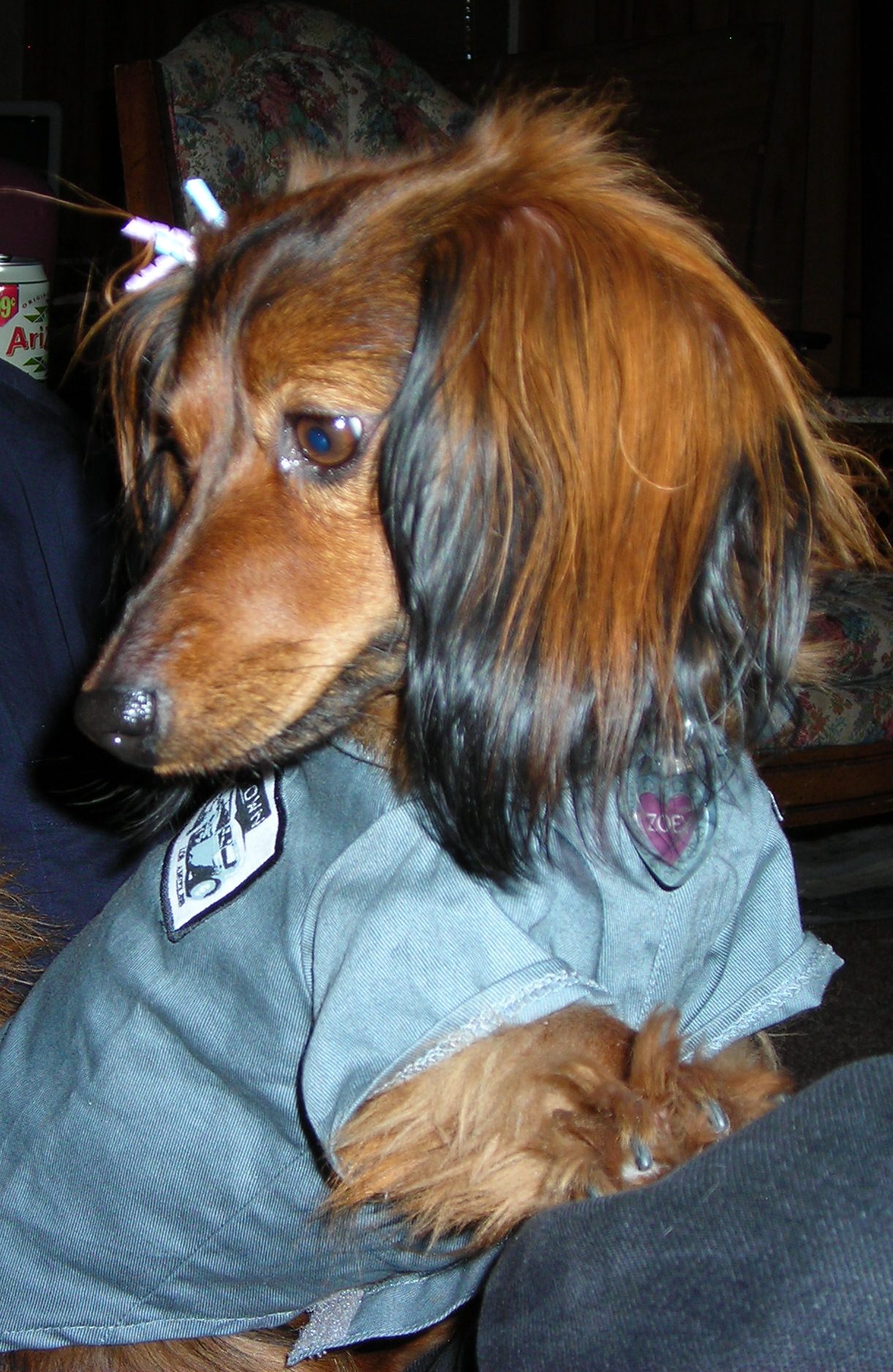
I’m not alpha dog, my nearly two-year-old miniature dachshund taught me. She rules the roost, is queen of the castle and has me wrapped around her paw. I’ve read dog training books, books about dog behavior and even one about “How Dogs Think.”

At the pet store, she seemed shy, just like me, as she shook and cuddled against my chest. I took her home and at bedtime put her in her kennel, but she made this pitiful crying, abused sound. I turned on the light and warned her that this was the only night we would share a bed. Her sad sounds got to me the next night and the third night, and that was that, I became her sleep buddy.

During the daytime, our relationship wasn’t so easy.

My first dog wasn’t a Marley, but Zoey liked being naughty and disliked the word “no.” She chewed on furniture, barked like a 100-pound dog and wanted to go in and out, in and out all day long, as if the grass were greener on whichever side of the fence she did not dominate.

When she was naughty, Zoey would not stop if I told her “no” and was even more determined to continue. If I ignored her or she wanted my attention, she would become even more mischievous. She was stubborn, manipulative and wanted her own way.

I considered throwing in the towel, selling her, returning her, taking her to the pound. I tried ignoring her, squirting her with a water gun, lightly spanking her behind and putting her in time-outs. Nothing seemed to work, except time and waiting for her to learn and to grow up. And I, too, had to learn how to not give up.

I was rewarded walking in the door after each day at work.

Zoey greeted me with wiggles starting with her tail that moved her whole body into alarcity. She leaped off the chair and ran circles around the coffee table, stopping for a pet before running more circles.

From Zoey, I learned what friendship means in simple language and how to give my heart to a dog. Usually, I am guarded when it comes to making friends. I was teased as a child for being shy and did not learn essential social skills, such as reading facial expressions and gestures. I carried this insecurity into my adulthood.

I lose my inhibitions with Zoey. She kisses me, lets me hug her for 30 seconds and invites me to play, play, play. At night, she snuggles smack against me leaning into my stomach, giving me a nightlong cuddle. I tell her that I love her and I know in her dog language, she says I love you back. I found the cliché to be true – my best friend is a dog.

Writing Basics, Beliefs and Beauty

Monday, February 6th, 2012

As a self-proclaimed word junkie, I get frustrated when I face the blank page.

When I told my friend about my blogging challenge for the year – 52: A Year of Writing Basics, Beliefs and Beauty – he asked, “How do you write a great opening scene?”

Understanding plot is an essential start, just as having a blueprint is necessary to build a house or an outline to write a college essay.

Without plot, there is no story, but unconnected moments of time like a broken string of pearls scattered on the ground. Stories follow a structure or framework called the narrative arc, which, simply put, is the story’s beginning, middle and end.

The opening scene needs a hook, or the inciting incident that gets the story moving. There should be some action, a character or two and a setting, which is the time and place where the action is occurring.

Readers will turn to page 2 and on to 3 and 4 if they care about the main character, whose actions drive the plot. The character has to have a goal or desire, whether it is romantic, emotional or practical.

This desire is what drives the character to act; otherwise the character would be just as happy watching TV or reading a book.

As the character goes for what she wants, she will face challenges, or obstacles, that become increasingly more difficult to overcome as the arc of the story rises upward.

The conflicts, whether internal or external, represent what the character is trying to resolve and are what creates these obstacles. The climax offers up the largest obstacle and determines whether the character actually gets what she wants.

The structure or framework, once in place, requires that everything in the story work together to tell the tale.

The other side of the arc, or the falling action to the story’s end, is where the character experiences some kind of revelation. Does she meet her goal? Or does her goal even matter anymore? Did she get something better (or worse) in her search to obtain her desires?

The resolution is where these revelations occur and where any loose ends are tied up, so that the strand of pearls becomes a full circle.

Flying from A to Z

Friday, January 6th, 2012

On a breezy, rainy Sunday, Tim and I sit underneath the balcony at the Mandolin Café, drinking coffee as we write about what ifs, or what about’s, or some big maybe.

A dog squeals down the street.

“The dog’s singing opera,” Tim says as he writes.

A brown-haired girls plays Pachebel’s Canon in D, a smile on her face.

Next to her, a thin woman with sleek gray hair under a beret pens in her journal.

And my dog Zoey sits underneath the table, looking down Fourth Street to where the other dog yips and yaps.

I want to get up and dance, but will words do?

The dog’s squeals start up again, riding on top of the piano notes, echoed by the tap-tap of our keyboards.

The sun slips out and the rain peppering my laptop slides away, as if the clouds are all wrung out.

I imagine Tim’s fingers moving up the body of his Fender Stratocaster as if she were a long-bodied woman. She’s white, cool and slick, this electric beauty that stings the stage with her wide mouthed squeals.

Tim seems to fondle the Fender’s neck as his fingers fly across the scales. The Fender melts with a howl as he swivels the song’s refrain into a furious flinging of movement. A hummingbird flitting around a tulip, this is how his hands look as he turns a song into dancing hands.

It’s his pickup of sound underneath the strings that turns a simple maybe into his dream of Flying V.

For Tim, it’s not a mandolin, a banjo, the piano, it’s this taking of guitar strings like telephone wires that carry sound into whole new meanings.

The Epiphone, the epic of flying from A to Z.

Re-Finding the American Dream

Tuesday, December 6th, 2011

If we could all live out our passions without greed and taking from others, the nation would not need Occupy Wall Street. I grit my teeth when I think about the hedge funds and stockholders that want to take their swipe from the corporate employees (not the CEOs, of course, who now earn rock star salaries).

But enough about politics.

I visited the Be You House earlier this month. Be You is the moniker for the Innovation Lab, an alternative program in Loveland, Colorado, that educates public school students by allowing them to identify, explore and follow their passions as opposed to prescribing their learning according to subject matter and state standards.

The Be You house is a 1910 Victorian home redesigned to fit the program with study, meeting and exploration spaces. I sat in the detox room, which is the starting point for students to let go of what is clogging their inner self, so that they can begin to be who they are.

I think too many of us are not living out who we are. Just drive somewhere and notice the angry, impatient drivers. Or listen to the public conversation about the shrinking middle class and the using up of the working class for fast profits.

Artists already know that they have to have some connection to their Be You-ness. Before creating something, colors, motions, sound and touch have to break the barrier of the skin and be internalized. They have to know what they want and love doing in order to create.

Too many people don’t know who they are, I think, because they are too busy surviving, be it to get the paycheck or to work corporate-demanded Energizer-rabbit hours. I find that when I try to fit into the corporate culture so that I can earn a paycheck, my Be You gets ignored or pushed aside and only peeks out when I start to notice nature or try to deep breathe.

In an offbeat sort of way, I think the protesters, or at least some of them, are tired of working or not working so that they can barely live. They are not living if there is no passion. They are just doing. They are not being. Being Free. Be You. That’s what I would define as the American Dream.

Finishing A Novel, Plus Forgiveness

Thursday, October 6th, 2011

With or without writing, I probably would have reached the same final emotion when I finished my novel: forgiveness.

This feeling arrived as if instant messaging me the day I completed my sixth edit. On that Sunday morning two weeks ago, I saw that I was finally done with “One April Day”– I had conducted enough repair work on the manuscript that I felt ready to start looking for an agent.

As I wrote, I didn’t expect to forgive, but the feeling came anyway. I wrote a fictionalized account of what had happened to me out of anger and curiosity – I wanted to tell the story of my layoff from a newspaper, a falling out with friends and my search for meaning in the upheaval.

I knew I needed to forgive, not for the sake of those who I should have let go, but for my own placidity. When this unsought for feeling hit me, I saw that the repair work had been on me.

I’m not sure how, but writing the story started my process of self-exploration. When I edited and reread the story, I found nuances both in my words and what I was trying to say. My loss entered the paper, like water needing to be wiped away, and became no longer mine.

The loss became a memory, something to stop holding onto after analyzing it from the angles of art and thought.

With that release, I didn’t have to drag along the past, like tin cans attached to a tailpipe. I could start the day and the next with a completed manuscript and a sewed up heart without the entanglements of what-ifs or I-should-have’s.

Imagine

Tuesday, September 6th, 2011

Here is a short poem I wrote last year, called “Imagine:”

Could you imagine

Life becoming

A plain in Nebraska

Not fighting for space –

Give me time –

The crowd too much

I could rise up

Let dreams

Give me back

To finding

That words let this and that

Just be.

An awkward conversation

Saturday, August 6th, 2011

With too many spaces between words, the talk turns into a battle of silence. What are you thinking, I wonder, as sparrows skip across empty patio tables. A game-after crowd hops in and out of chairs, yelling over conversation layers as they spill into back slapping.

“Guess who’s the flavor of the week?” one of the gaggle giggles.

Whoever he is, he’s just a number I figure as I lose the disco dance of her words.

I wish I knew what that was like. I could stray into drink and trash talk, instead of engaging in the serious business of shyness.

How do the shy, boring people talk? But are we boring, him and I? Introverts find it too hard to translate into language the inner rollercoaster of quiet, reflective observations.

How can I tell him that words are how I breathe, the written ones, not the ones I wish I knew how to sling into the comfort of being with another.

I start telling him a story, but it goes nowhere, and I feel stupid. That’s how I often feel, but it’s not exactly an emotion. It’s more of a sad-edged embarrassment that sours my tongue.

I ask him, “Are you bored?”

No, no, it’s okay, he says.

I lower my head and stare at my plate. I lift my fork and taste discomfort, afraid to look at him. I think about lists of questions and wait for the sound of his voice. I look up, seeing that the stillness of my breath makes shyness scream in my ears.

And I smile. He smiles back, almost as if he were frowning. And we begin to talk about something of little importance, what I can’t remember. All I remember is the bitter taste of bad conversation tightening my chest as I forget how to relax and just be myself.

I don’t know how to do that with someone who’s more of an introvert than me. But then I feel lucky that I can talk, strike up conversations and get the surprise that other people don’t consider me shy.

Burndt Sienna Heart

Wednesday, July 6th, 2011

I have a broken crayon in my heart:

It used to be razzle dazzle rose with the hope of you.

After a decade gone by, your memory had become fuzzy wuzzy or even basic brown. I had forgotten until your apology and nine months of Facebook flirtations.

“I was a jerk,” you said. Sorry, sorry, you said.

I re-sharpened my mango tango limbs and tried to be my most exotic shade, a rose quarts that would capture your notice. But you came, you saw and you did not want to conquer.

I could see it in your cerulean blue eyes darkened like coal.

“Am I boring you?” I asked, and got your no, no.

Our five-day trip broke to three.

You needed something in the wild blue yonder. You needed confetti glitter, a spark like firecracker red.

I didn’t have it despite my magic potion purple attempts to be beautiful.

You left, and I felt the lemon-lime zing.

My tears were atomic tangerine, as if they could get me back to basic green when all I really wanted was you, not this broken heart.

I had a taste of my wild watermelon, and with this one lick, I’m off road and don’t know what to do.

I don’t know which crayon is right for me even with 120 colors.

Or is it that I need black to cover memories and hurts and the titanium white look of you. I could scratch off the pieces until a new palette results, like the bitter taste of key lime with a sweet after-tickle on the tongue.